The Productivity Paradox: A Lesson from the Factory Floor
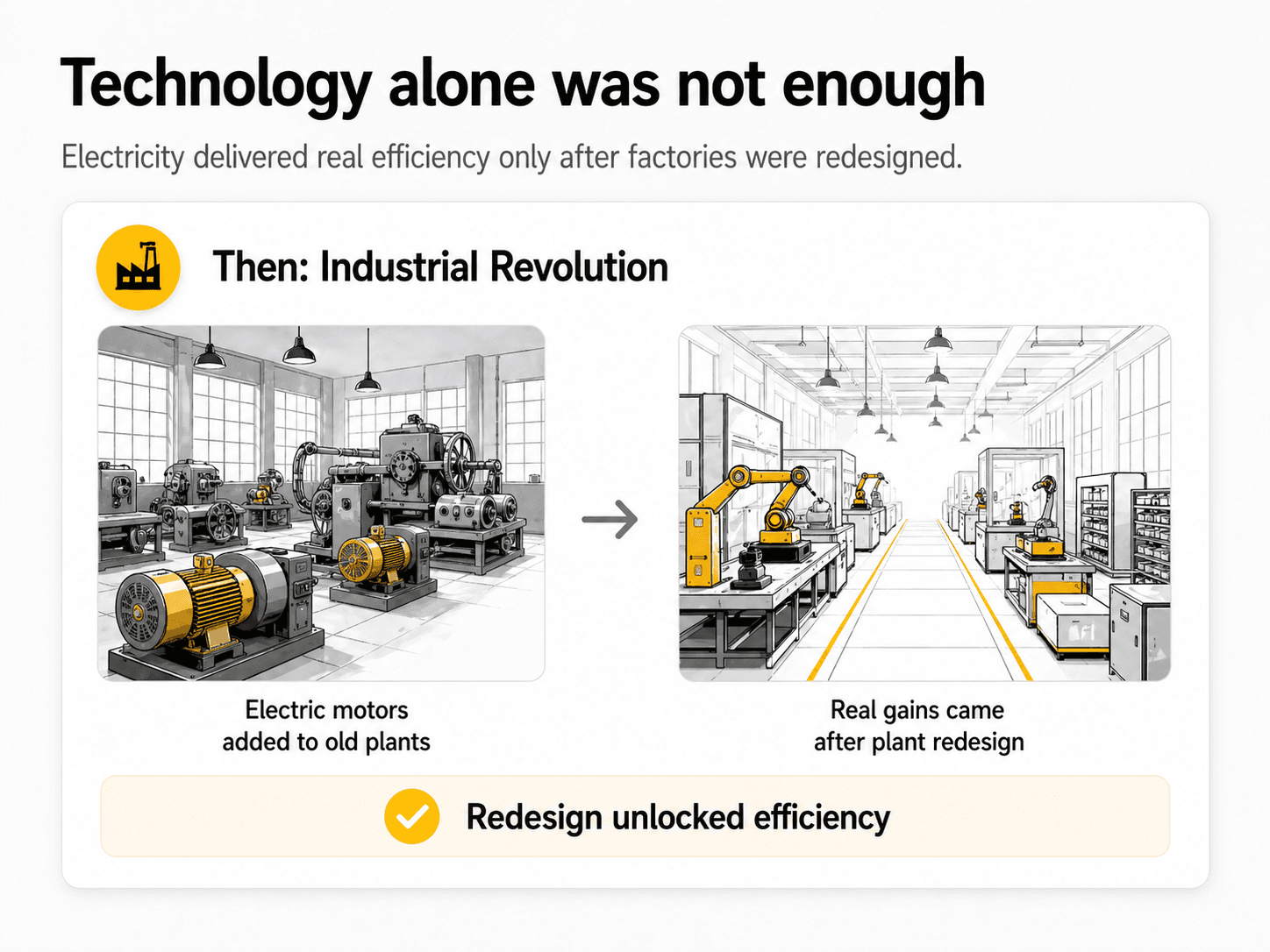
During the Second Industrial Revolution, the initial introduction of electricity to factories did not yield immediate productivity gains. For decades, efficiency remained flat. Why? Because factory owners simply removed their massive, centralized steam engines and replaced them with massive, centralized electric motors. The physical layout of the factory, which had been awkwardly designed around a complex system of belts and line shafts to distribute steam power, remained exactly the same.
It was not until a generation later that engineers realized electricity's true potential: power could be distributed. By attaching small, specialized electric motors to individual machines, they could completely redesign the factory floor around the natural flow of work rather than the constraints of the power source. Only then did industrial productivity skyrocket.
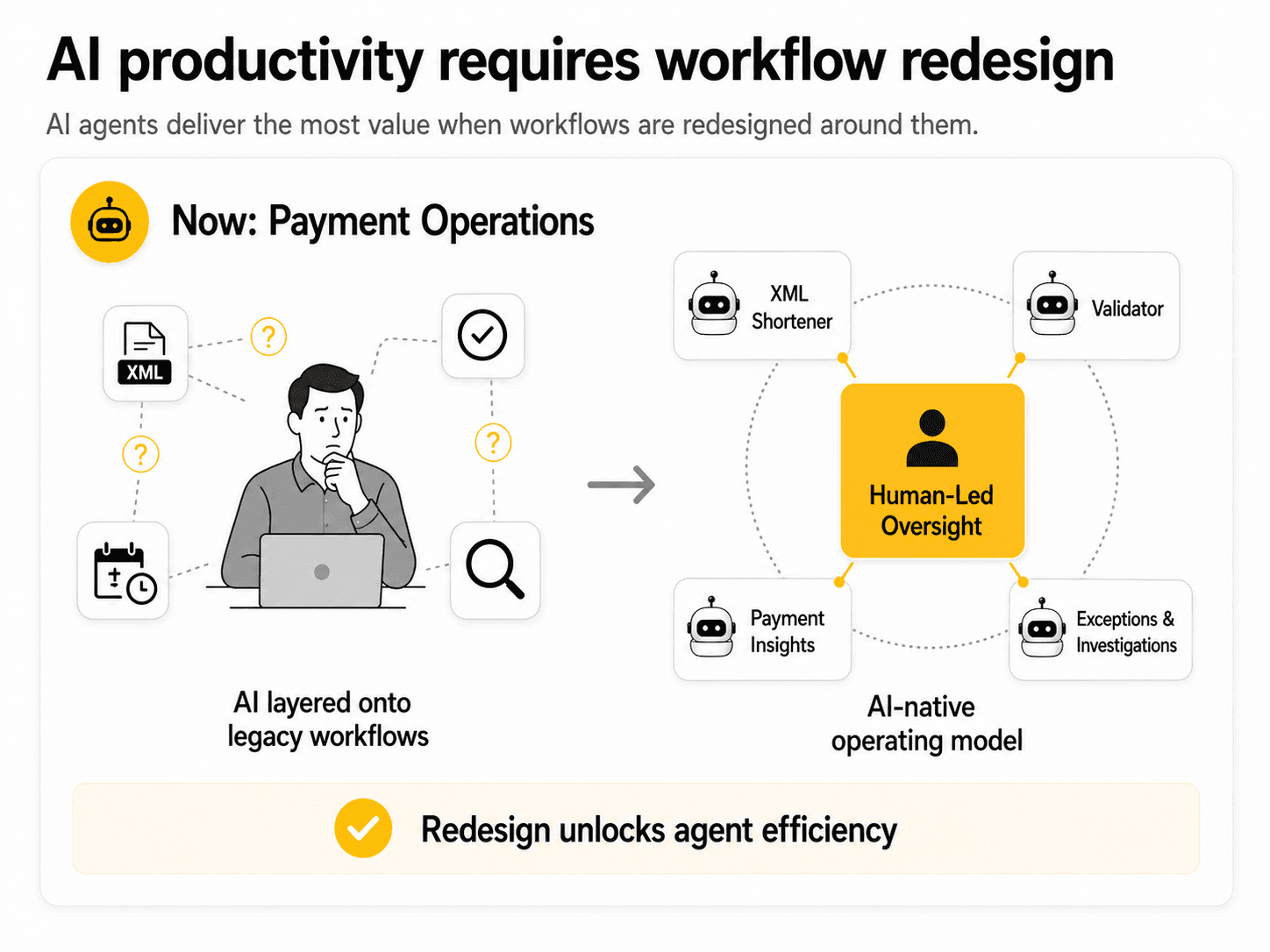
We are currently at this exact same juncture with Artificial Intelligence in financial operations.
Today, the industry is trying to bolt massive, generalized LLMs onto legacy, linear workflows. We are treating AI like a drop-in replacement for old technology without changing the operational layout. To unlock the true efficiency gains of AI, the operational plant must be redesigned from the ground up.
The Operational Challenge Today
Operations teams are being pushed into richer SWIFT MX / ISO 20022 messages, but the day-to-day reality remains incredibly difficult. Raw XML is hard to read, validation issues are time-consuming to resolve, payment lifecycle visibility is fragmented, and exceptions often require manual, tedious investigation across multiple convoluted messages. The legacy factory floor is breaking down under the weight of this new data standard.
The Product Wedge Today
Bright InvestOps starts with the practical foundation: making SWIFT MX operationally usable for humans.
The foundational modules help teams:
- interpret complex ISO 20022 messages
- validate CBPR+ data more effectively
- track payment lifecycle events
- investigate operational issues faster
This creates a clean operational baseline: structured data, visible workflows, and human-readable context.
The Roadmap Forward: An AI-Native Workspace
This operational foundation is the basis for our next phase: building a true AI-Native system.
Rather than treating AI as a generic chatbot on the side of a screen, Bright InvestOps has redesigned the factory floor. We have created an environment specifically architected for specialized AI agents to work within, managed and orchestrated by Payments Operations professionals.
Just like the specialized electric motors that revolutionized manufacturing, our AI agents are distributed, purpose-built, and attached directly to specific operational nodes.
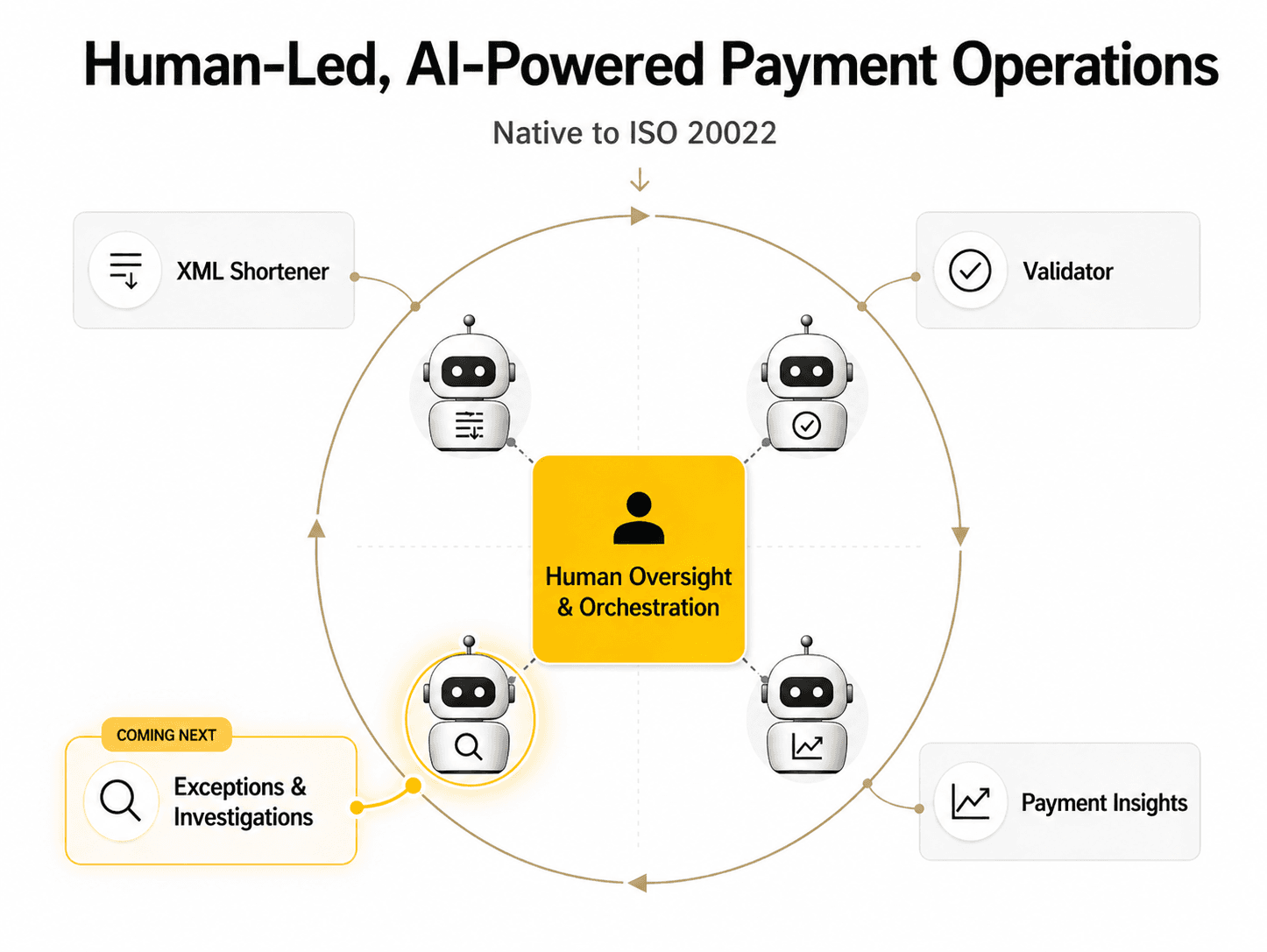
As illustrated in our operational model, the workflow is no longer a rigid, linear pipeline. Instead, it is a dynamic, continuous loop Native to ISO 20022:
The Core
The human expert sits at the center, providing Oversight & Orchestration. They are the modern plant managers, guiding the system rather than grinding through the gears.
The Specialized Agents
Surrounding the human are specialized AI agents, our modern electric motors, each handling a distinct, heavy-lifting task:
- XML Shortener: Instantly parsing and distilling complex ISO 20022 messages into human-readable context.
- Validator: Proactively catching formatting and compliance errors before they cascade.
- Payment Insights: Analyzing the lifecycle and extracting strategic value from payment flows.
- Exceptions & Investigations: Autonomously gathering context across multiple messages to present the human operator with a ready-to-solve case.
By redesigning the operational layout to be AI-Native, Bright InvestOps empowers human professionals to stop acting like manual data processors, and start acting like orchestrators of a highly efficient, intelligent, and scalable payment ecosystem.